
At the end of May, we will release a new book, Narratives of Hungary. This is a collection of personal essays, articles, and interviews exploring various aspects of life in Hungary. Narratives of Hungary is a companion to Narratives of Budapest (released in 2024), an overview of the independent cultural and artistic scene of Hungary’s capital city. With the new edition, we expand our focus to the entire country, seeking out the voices, places, and traditions that make Hungary so distinctive. Today, we are publishing an excerpt from the essay “A Red Suzuki Swift on Hungarian Byways” by Peter Haldeman, featured in the collection.
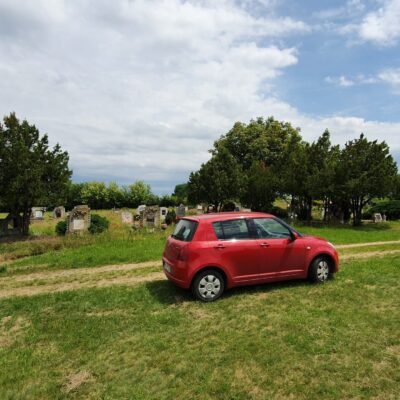
“Sorry, Gábor.”
Many trips into the countryside have been punctuated with this apology, though Gábor, the neighbor who has rented us the four-cylinder Suzuki with its low suspension, is not there to hear it. Explorations on sideroads to ruins and up hillsides to clusters of winepress houses and other curiosities have frequently placed us on severely rutted trails, up pitted gravel roads spiked with boulders, or scraping past roadside vegetation run riot. For this we voiced our sincerest apologies to Gábor. A military-grade jeep would have been more appropriate to the terrain.
*
On a bright, warm summer Sunday, we ask ourselves if we wouldn’t like to drive to the open-air market at Káptalantóti. I drive the Suzuki west out of Budapest on the M7 along low rolling hills, past Lake Velence, curling right around the back of Székesfehérvár, where Hungary’s first kings were crowned and buried. The road continues past the three large cooling towers of the Inota thermal power plant and the ruins of the former Habsburg and Soviet army barracks at Hajmáskér, then on past Veszprém, City of Queens, and Nagyvázsony and its Kinizsi Castle and their legends of Hungary’s 19th century highwaymen, the betyárok. The road then drops down into the Lake Balaton Uplands, through Szentantalfa with its ruins of the 13th century St. Balázs church, and it is here, on the approach to Zánka, that the ethereal aquamarine waters of Lake Balaton first appear on our horizon. We will get there – we will end our journey west today at Badacsonytomaj on the shores of the lake. But first, passing by the basalt cliffs of Monoszló and the lovely inns and restaurants of Köveskál, we arrive at our first destination, the Liliomkert Piac, the Lily Garden Marketplace of Káptalantóti.
We park the car and plunge into the crowds surging through the byzantine maze of the market, mingling with holidaymakers breaking from summer lakeside hedonism and indolence. Wines and syrups, honeys and jams, ceramics and paintings, antiques and old books, smoked meats and crackers, clothing and jewelry, fresh breads and produce, the fare is spread throughout market stalls under a light canopy of trees on a late Sunday morning, and we peruse eagerly.
We continue from Káptalantóti to nearby Szent György-hegy (St. George hill) wrapped in basalt columns and vineyards, beside the iconic butte of Badacsony on Balaton’s west side. We take a walk from the Polish chapel, past vines heavy with fruit; up the path are a few wine cellars, and a view of the distant hilltop castle of Szigliget. But today I have one more objective: to see the Good News Orthodox chapel, a converted winepress house tucked away in the woods on the backside of the hill. We get back in the Suzuki to circle around closer to this curiosity discovered on Google Maps. Our GPS, however, picks a rough country lane, and still with some distance to go, we give up the chase. Would we have found Father Márton there, a 21st century stonemason and hermit who should be disturbed only with the utmost graciousness? No matter. The Suzuki is not ours to be tested this way, and we still have an afternoon at the lake in front of us. We gingerly ease the car back down the hill, scraping through the summer weeds.
“Sorry, Gábor.”
Leave a Reply