I arrived in a village in Bulgaria's Pernik region on January 13 to photograph monsters.
That was the word I wrote in my notebook.
Monsters.
Later I crossed it out.
The men were getting ready in a barn, strapping enormous bells around their waists and checking
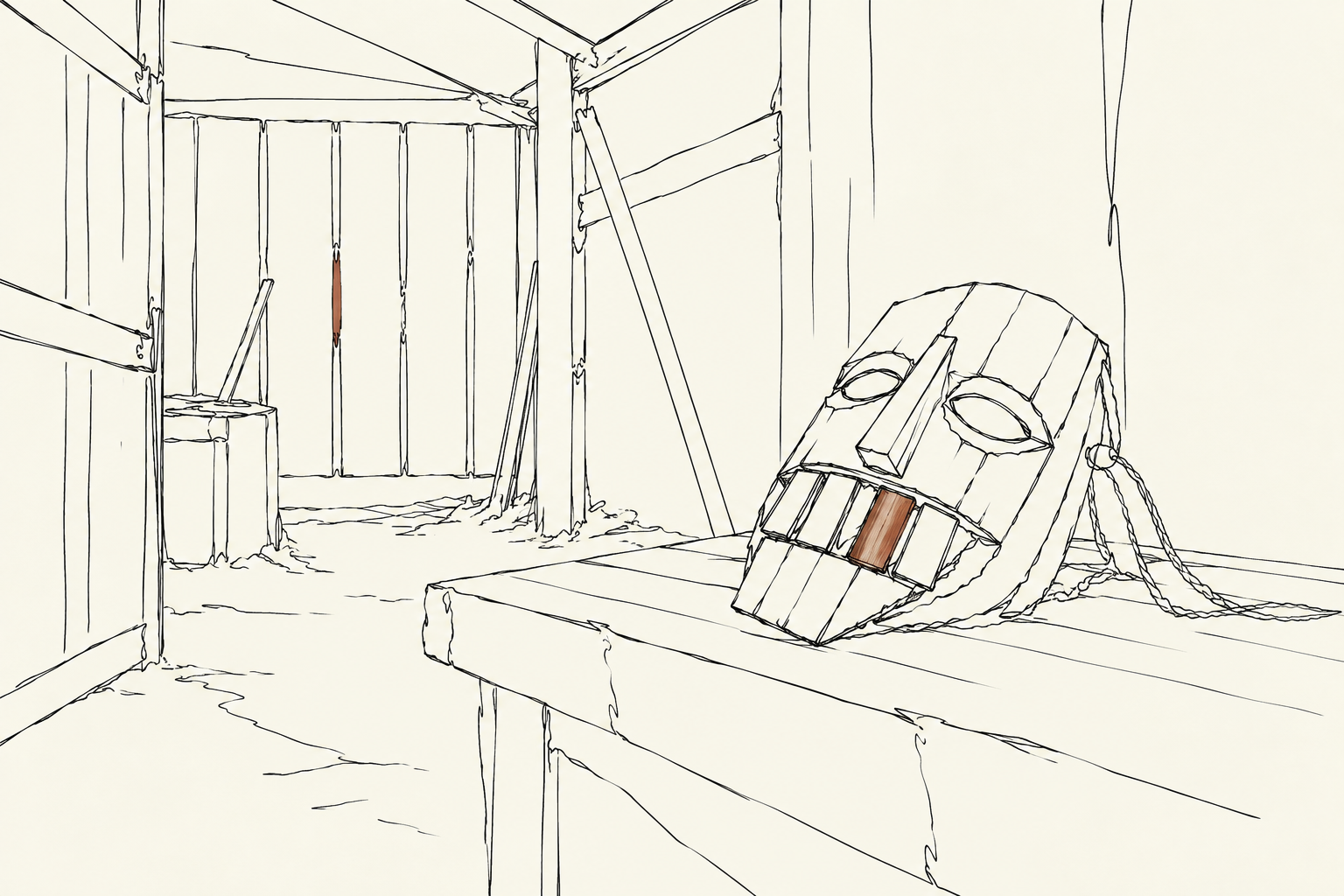
hides, wool, feathers, horns. Some masks had wooden teeth. Others looked like animals remembered
badly after many years.
An old man watched me from the back of the room.
His name was Petar.
"How long does it take to make one?"
"Sometimes a year."
I laughed.
He did not.
He lifted a long mask covered in dark fur. Two horns rose from its head. Its mouth hung open in an
impossible grin.
"And how long does it last?"
Petar ran a hand over the fur.
"Longer than the face."
That night, the village began to tremble.
Hundreds of bells struck against moving bodies, and the sound seemed to rise from the earth. The
survakari danced around the fires. There was a bear, a bride, a priest, children hidden inside heads
larger than their own.
I photographed until I could no longer feel my fingers.
Then I saw Petar's mask across the fire.
The figure wearing it was not dancing.
It was looking at me.
I took a photograph.
When I lowered the camera, it was gone.
I found Petar.
"Who did you lend that mask to?"
"Which one?"
I described it.
"That one never left the barn."
I showed him the photograph.
The figure stood behind the dancers.
Petar studied the screen.
Then he asked my name.
"Pedro."
He repeated it softly.
"Do not photograph it again."
"Why?"
He handed the camera back.
"Because now it knows where to put you."
The next morning he was waiting outside my lodging with the mask under one arm.
"Did you dream?"
"I don't remember."
He seemed pleased.
At his house, old festival photographs covered a wall. He pointed to one from 1987. Two masked
men stood beside a fire.
"This was my brother."
"Which one?"
Petar smiled.
"That stopped mattering."
His brother had died that winter.
The mask had not.
One of the figures wore two horns and dark fur.
"Is it the same one?"
"Perhaps."
"Who was inside it last night?"
Petar looked at me as though I were a child.
"You still think someone is inside."
Back in my room, I downloaded three hundred and twelve photographs.
The mask appeared in eleven.
In the first, it was far away.
Then closer.
Then behind a fire.
Then beside a child.
By the tenth photograph, it was no longer looking at the camera.
It was looking at something behind me.
The last photograph showed no fire, no dancers, no village.
Only the inside of the barn.
The mask lay on the table.
Empty.
Beside it was my camera.
And behind the camera stood me, with my back turned.
The photograph could not exist.
I had been the one taking it.
I enlarged the image.
In the reflection of a small window, I could see my face.
Or what should have been my face.
The image was dark.
But there were two horns.
I closed the computer.
I did not open that photograph again until I was back in Portugal.
By then, it had changed.
The barn remained.
The camera too.
But there was no one behind it.
Only the mask on the table.
Months later, Petar sent me a photograph from the next festival.
No message.
A crowd of survakari moved through the snow.
Far behind them, almost lost among the bodies, I recognised the dark-furred mask.
I enlarged the image.
Behind the wooden teeth was a face.
It was not mine.
Not yet.
Pedro Novo is a Portuguese writer and photographer from Paços de Brandão, in northern Portugal. His work explores memory, travel, folklore and landscape, and the uneasy territory between lived experience and the surreal. Years of travelling through remote places and different cultures increasingly shape his fiction. His stories often begin with ordinary people, objects and places before moving quietly towards myth, ambiguity and the uncanny. Alongside fiction, he develops literary and photographic projects rooted in oral tradition, collective memory and the ways people stay bound to the land they come from.

Leave a Reply